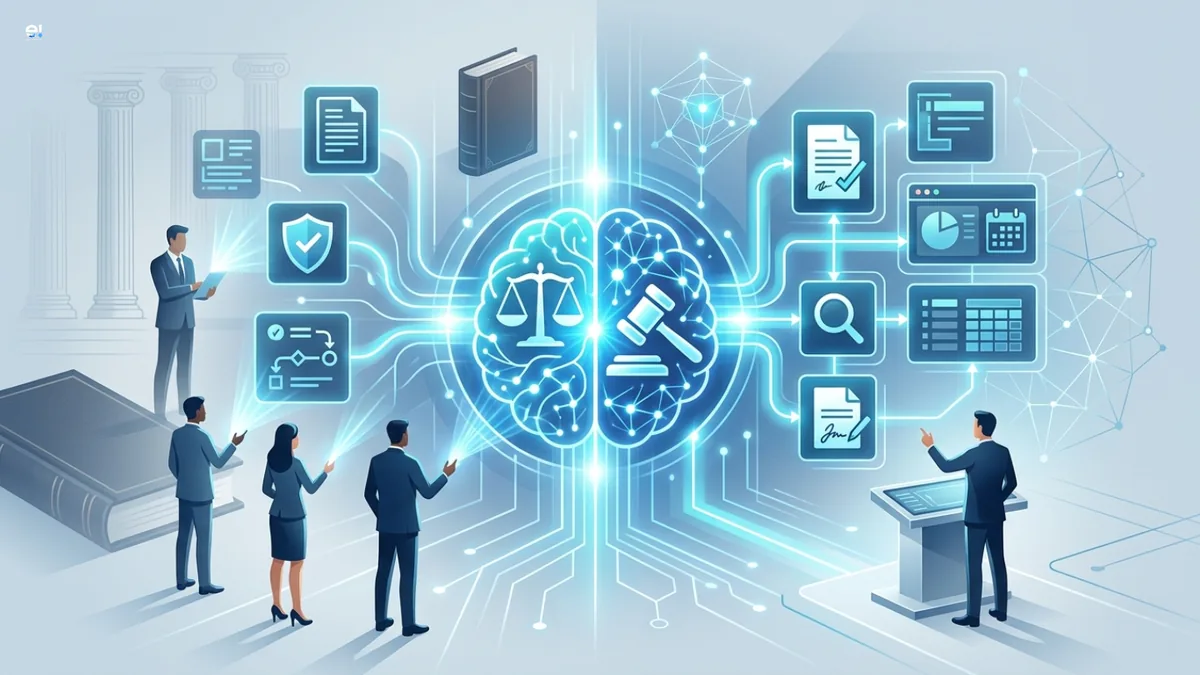
AI Contract Drafting Tools & No-Code Legal Automation

Legal contracts, integrated with AI automation and no-code platforms, are revolutionizing legal tech and various industries. This article highlights their role in enhancing legal processes and business operations, and in democratizing contract creation. It explores how these technologies simplify complex tasks and shape the future of legal and business landscapes.
1. Introduction to Legal Contracts and AI Automation
The integration of AI and automation in Legal Contracts represents a significant advancement. This combination ensures automated, efficient, and error-free execution of contractual terms. It’s a groundbreaking development that transcends traditional contract management methods.
This synergy is particularly impactful in industries such as finance, legal, and logistics. In these sectors, it streamlines processes, enhances transparency, and significantly reduces operational costs. The use of AI and No Code Automation tools in these areas leads to more efficient and reliable transactions. For a broader perspective, see our legal automation contracts overview.
The fusion of Legal Contract creation process and AI heralds a new era in contract management, marking a shift towards more intelligent, autonomous systems across various sectors, promising a future of enhanced efficiency and reduced human error.
2. The Evolution and Advantages of No-Code Platforms
No-code platforms have revolutionized Legal Contract development and deployment. They enable individuals without coding background to design Legal Contracts using no-code tools that maximize legal operations, opening doors for various industries.
These platforms are not just about ease of use; they empower businesses and individuals to engage with advanced technologies. With pre-built templates and drag-and-drop features, the creation of Contracts becomes quicker and more intuitive, fostering innovation and creative solutions across sectors.
Additionally, no-code solutions often integrate advanced AI tools, enhancing the functionality and efficiency of Legal Contracts through:
- Intelligent analytics
- Predictive modeling
- Automated workflows
AI assists in analyzing contract terms, predicting potential issues, and suggesting optimizations, ensuring contracts are effective and adaptable. Learn more in our AI contract analysis whitepaper.
The emergence of no-code platforms signifies a pivotal moment in the evolution of Legal Contracts, making them more accessible and powerful, paving the way for wider adoption and innovative applications across multiple industries.
3. Transforming Legal Processes with AI-Driven Legal Contracts
AI and no-code automation integrated into Legal Contract creation is dramatically transforming the legal industry. These tools automate routine tasks such as document review and compliance checks. AI-driven Legal Contracts free up legal professionals to focus on more strategic aspects of their work.
This technology is not just about efficiency; it’s about enhancing the accuracy and reliability of legal transactions. Automated Contracts reduce the likelihood of human error, ensuring precise execution of agreements, crucial in legal contexts.
Automated Contracts can be applied in various legal areas, including:
- Intellectual property management — automating royalty payments
- Corporate governance — streamlining shareholder agreements
- Contract law — standardizing contract creation and review
The future of legal technology is shaped by the capabilities of AI-driven Legal Contracts. As these technologies evolve, they promise to bring innovative solutions to the legal sector.
4. Enhancing Business Operations
Legal Contracts, powered by AI, are enhancing business operations across various sectors. These automated contracts ensure faster, more reliable, and cost-effective execution of agreements.
AI analyzes large volumes of contract data, providing businesses with actionable insights and predictive analytics. In supply chain management, AI-driven Legal Contracts can predict and manage inventory levels, improving efficiency.
Automated Contracts also play a critical role in customer relations, where personalized contracts are automatically adjusted based on customer behavior. This personalization is crucial in today’s competitive business landscape.
The impact of Legal Contracts on business efficiency is profound, streamlining operations and opening new avenues for innovation and customer engagement.
5. Navigating Challenges
Implementing AI and no-code automation for Legal Contracts offers numerous benefits but also presents challenges:
- Legal Contracts require high accuracy and foresight in design to avoid future issues
- Security is crucial as Legal Contracts handle sensitive transactions, requiring ongoing vigilance and updates
- Regulatory uncertainties pose a challenge, as the legal framework is continuously evolving and requires careful navigation and compliance with existing laws
Despite these challenges, the potential of using AI and automation for Contracts is immense. Advancements in AI and no-code platforms are addressing these concerns, making Legal Contracts more secure, user-friendly, and compliant with legal standards.
6. The Downside of AI in Contract Creation and the Advantage of Rule-Based Approaches
While AI offers substantial benefits in the creation of legal contracts, it is not without its limitations. AI systems, at times, may not fully grasp the nuanced language and specific legal contexts, which can lead to errors in interpretation and application. This is particularly problematic in complex legal scenarios that demand a deep understanding of legal nuances and expertise.
In such instances, a rule-based approach with variables might be more advantageous for legal contract creation. This method relies on predefined rules and conditions to formulate contracts, providing greater control and precision. It’s especially beneficial in situations where legal contracts need to strictly adhere to legal standards or in highly specialized legal domains.
Rule-based systems offer a more dependable framework for creating legal contracts in these contexts. They minimize the risk of misinterpretation and ensure that the contracts adhere strictly to legal requirements and standards. This approach can be crucial in maintaining legal integrity and compliance, particularly in areas with stringent legal regulations.
7. The Future of Legal Contracts in a Balanced Tech Landscape
The legal tech industry is witnessing a significant evolution, shaping the future of legal contracts. This future is characterized by a balanced approach, where AI-driven legal contracts and rule-based methodologies coexist.
AI’s role in legal contracts is expanding, offering intuitive and adaptive solutions. These advancements bring efficiency and a level of innovation to legal contract creation, making complex tasks more manageable.
Simultaneously, the importance of rule-based approaches in legal contract creation remains vital. In complex scenarios where precision and strict adherence to legal standards are crucial, rule-based systems provide the necessary reliability and accuracy.
This emerging landscape in legal contract creation signifies a harmonious blend of technology and traditional precision. It reflects an understanding that both AI and rule-based systems have unique strengths, valuable in different legal contexts.
Conclusion
The integration of AI and no-code platforms has transformed legal contracts, enhancing efficiency and accessibility. However, this transformation also brings to light the limitations of AI in comprehending the intricate aspects of legal language and contexts.
Recognizing the value of rule-based approaches in certain complex legal scenarios is crucial. These scenarios demand a high level of precision and strict compliance, areas where rule-based systems excel.
As we move forward, the future of legal contracts in legal tech will likely encompass a blend of AI innovation and the structured robustness of rule-based systems. This approach promises a future where legal contract management is not only automated and intelligent but also legally sound and precise, meeting diverse legal requirements and standards.
Frequently Asked Questions
What are the main benefits of integrating AI with legal contracts?
Integrating AI with legal contracts offers several key benefits: Efficiency – AI automates routine tasks such as document review and compliance checks. Accuracy – Automated systems reduce human error, ensuring precise execution. Cost-Effectiveness – AI-driven processes streamline operations, reducing costs. Insightful Analytics – AI provides predictive modeling and intelligent analytics to foresee and mitigate potential issues.
How do no-code platforms impact the creation and management of legal contracts?
No-code platforms significantly impact legal contracts by: Accessibility – allowing individuals without coding expertise to design contracts. Ease of Use – pre-built templates and drag-and-drop features make creation faster. Integration with AI – enhancing functionality with intelligent analytics. Innovation – enabling businesses to engage with advanced technologies.
What challenges are associated with using AI and no-code platforms for legal contracts?
Challenges include ensuring high accuracy in contract design, maintaining security for sensitive transactions, navigating regulatory compliance with evolving legal frameworks, and addressing AI’s limitations with nuanced legal language that may lead to interpretation errors.
In what ways are AI-driven legal contracts transforming business operations?
AI-driven legal contracts enhance business operations through faster execution of agreements, data analysis providing actionable insights, improved efficiency in supply chain management, and personalization of contracts based on customer behavior.
Ready to automate your legal workflows?
Discover how e! can transform your legal operations with no-code automation.