Legal Automation Blog | LegalTech & AI Insights
Stay up to date with the latest trends in legal automation, AI, no-code technology and vibe coding.
-
 • 11 min read
AI Act GPAI enforcement: 8 questions for your AI vendor
Since 2 August 2026 the European Commission, through its AI Office, can enforce the obligations of providers of large AI models. Law firms and legal departments are not the addressees of the rules, but they are affected as soon as their tool runs on such a model. Eight questions to put to your tool vendor, and how to judge the answers.
By Pascal Di Prima Read more → -
 • 11 min read
AI-drafted court filings: why review now decides the cost
Generative AI has made legal drafting almost free, but reading and checking still cost time. Courts in Germany and Austria have started to say so, researchers call the pattern "agentic flooding", and Austria has written conditions for automated decisions into law. Firms and legal departments that build structure and a named review step into drafting will be better prepared than those that rely on volume.
By Maraja Fistanić Read more → -
 • 7 min read
What Is a Legal Engineer? Role and Relevance for Law Firms and Legal Departments
Large firms, mid-sized practices and in-house legal departments in Germany are actively hiring legal engineers. What the role involves, why it has become relevant so quickly, and whether you really need one to implement AI and automation in legal work.
By Maraja Fistanić Read more → -
 • 10 min read
California's SB 574 as an AI self-check for German and European law firms
California's SB 574 sets four duties for lawyers who use generative AI. German law firms are not bound by it, but the four duties work as a self-check: could your firm prove its AI use with documents, or only with assurances?
By Pascal Di Prima Read more → -
 • 10 min read
AI Strategy for Law Firms: The Path to Becoming AI-First
AI-first doesn't mean reinventing your firm. It means making AI the default for specific, well-defined tasks. A roadmap, the legal guardrails in Germany, and a real case study for partners at mid-sized firms.
By Maraja Fistanić Read more → -
 • 8 min read
CRA incident reporting: what in-house legal must settle first
Cyber Resilience Act reporting does not fail on the legal analysis: it fails at four operational points, and in-house legal can settle all four on a single page before the first incident arrives.
By Pascal Di Prima Read more → -
 • 8 min read
Article 50 EU AI Act: An Operational Check for In-House Legal
Article 50 of the EU AI Act has applied since 2 August 2026, and the work it creates for in-house legal is not drafting a policy but building an inventory of live AI systems and deciding, system by system, whether the organisation acts as provider or deployer.
By Pascal Di Prima Read more → -
 • 6 min read
Why In-House Legal Needs a Different AI Strategy Than Law Firms
Law firms and in-house legal teams lived through the same chat-AI moment. Agentic AI is where their paths split, and the in-house question isn't speed, it's what the legal function actually delivers.
By Maraja Fistanić Read more → -
 • 8 min read
Using AI Safely: A Practical Guide for Lawyers
A junior associate almost sent an AI-drafted summary straight to a partner before catching an invented clause. Practical guidance on AI literacy, key terms in real use, common mistakes, and the safeguards that keep AI useful instead of risky.
By Hananeh Read more → -
 • 8 min read
Three Levels of AI Automation for Legal Teams
Most legal AI use stops at manual chat. Here's the three-level maturity path to scheduled automation, what the new Bot Scheduler feature does, and honest answers to "why not just build this myself with Claude or ChatGPT?"
By Pascal Di Prima Read more → -
 • 8 min read
AI Readiness for In-House Legal Teams: From Pilot to Operations
Most in-house legal teams have already tried AI informally. Here's how to move from scattered pilots to a governed, auditable operation, with a practical readiness checklist and a real case study.
By Maraja Fistanić Read more → -
 • 8 min read
e! by Lexemo vs. Microsoft Copilot for Legal Teams
Microsoft Copilot and e! by Lexemo both bring AI into legal work, but they solve different problems. A side-by-side look at what each one actually does, where they overlap, and when a legal team needs both.
By Hananeh Read more → -
 • 6 min read
No-Code Tools for Legal Operations: 3 Key Benefits
No code tools offer a perfect solution for legal operations teams seeking innovative ways to enhance their services while staying within budget. Discover how these tools empower legal ops personnel to automate routine processes.
By Hananeh Read more → -
 • 9 min read
AI Literacy for Lawyers: Why Understanding the Tech Is a Professional Duty
Using legal AI you do not understand is a professional risk, not a shortcut. Why AI literacy is becoming part of a lawyer's duty of competence, and four steps to build it, from law school to the corner office.
By Maraja Fistanić Read more → -
 • 8 min read
Vibe Coding or Structured Automation? A Decision Framework for Lawyers
Not every legal automation belongs in a chat window. A practical framework, comparison table, and worked example for deciding when to vibe code an internal tool yourself and when it needs a structured platform instead.
By Hananeh Read more → -
 • 10 min read
The 5 Best Legal Automation Tools for Legal Departments (2026)
Legal departments are handing routine work to no-code automation. Five legal automation tools compared for 2026, judged on ownership, workflows, document automation, reliability, and GDPR and BDSG fit.
By Lexemo Team Read more → -
 • 7 min read
Procurement Compliance Automation: No-Code Workflows for Legal and Ops Teams
Procurement compliance work generates a disproportionate share of administrative load for legal and ops teams. No-code workflow automation reduces that without requiring custom software or IT involvement.
By Hananeh Read more → -
 • 7 min read
Legal Intake Automation: Self-Service Forms, Email Triage, and Query Routing
Legal teams spend significant time on incoming requests that follow predictable patterns. Structured intake forms, email triage workflows, and automated query routing reduce that overhead without removing the lawyer from substantive decisions.
By Hananeh Read more → -
 • 7 min read
Automation for Commercial Real Estate Law
Commercial real estate legal teams handle some of the most document-heavy transactions in the legal industry. Here is where workflow automation reduces the administrative load without changing how legal decisions get made.
By Hananeh Read more → -
 • 8 min read
How FinTech Legal Teams Use Automation to Manage Compliance at Scale
FinTech legal teams manage high regulatory volume with lean headcount. Workflow automation, not AI replacing lawyers, is how the best teams stay on top of KYC documentation, regulatory change tracking, and contract routing.
By Pascal Di Prima Read more → -
 • 8 min read
AI in the Legal Department: Use Cases, Limits, and How to Get Started
AI is changing how in-house legal teams work, but not in the way most people expect. Here are the realistic use cases, clear limits, and concrete first steps for legal departments.
By Lexemo Team Read more → -
 • 8 min read
Finding AI Multipliers in Your Law Firm: A Practical Guide
AI projects in law firms rarely fail because of the technology. They fail because of missing internal buy-in. Here is how to find the multipliers who make adoption stick.
By Hananeh Read more → -
 • 7 min read
Why AI Agents Alone Can't Automate Legal Work
AI is excellent at identifying problems, but it often fails to solve them. Platforms like e! by Lexemo are closing this gap with Pro Agent Tools that move beyond analysis to actually execute tasks.
By Pascal Di Prima Read more → -
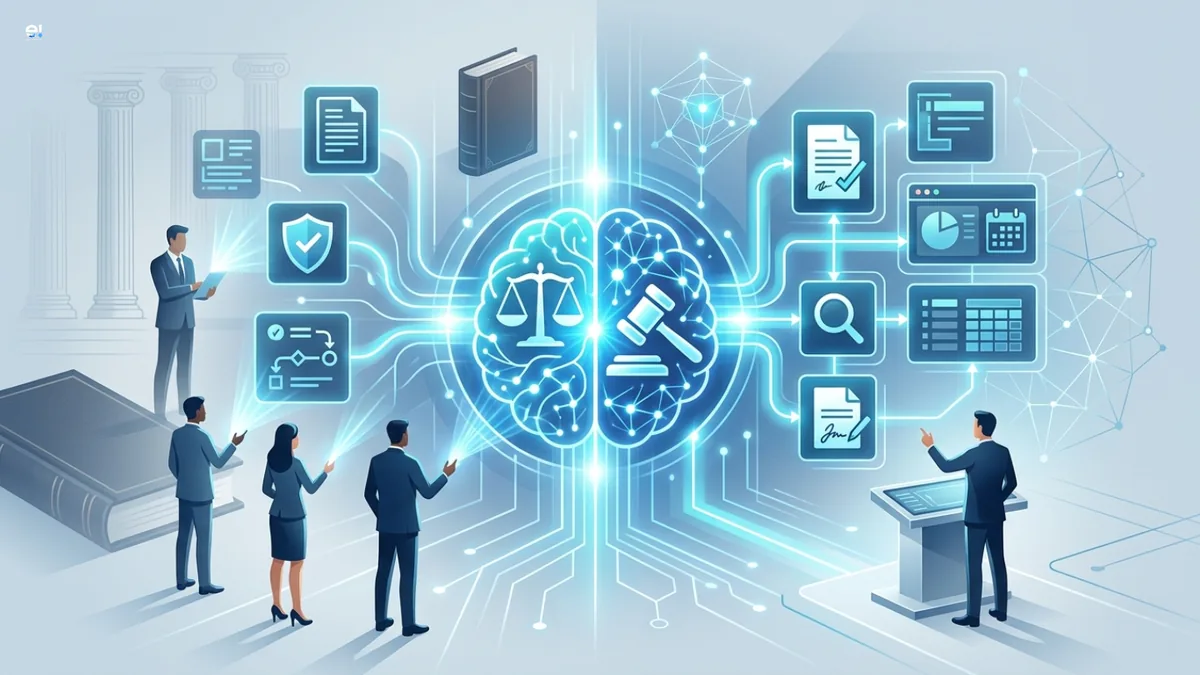 • 6 min read
AI Automation for Lawyers: The Power of Vibe Coding
Lawyers are building their own AI-powered tools — often in a single afternoon. This is vibe coding in legal tech, and it is already reshaping the profession.
By Lexemo Team Read more → -
 • 8 min
Gemini Embedding 2: Unified Legal AI Search Across All Formats
Legal teams struggle with fragmented search across formats. Gemini Embedding 2 unifies retrieval across all content types.
By Pascal Di Prima Read more → -
 • 8 min read
Legal Tech Tools Overview: Categories & No-Code Automation
An overview of the most important legal tech categories — from no-code workflow automation to contract management — and how to deploy them strategically.
By Lexemo Team Read more → -
 • 8 min read
How to Find High-Impact Legal Workflow Automation Opportunities
Discover how to identify and prioritize legal workflow automation opportunities that deliver the highest ROI for your organization.
By Hananeh Read more → -
 • 10 min read
Why AI Prompts Fail — And How to Write Better Ones
Imagine asking an AI assistant a simple question and getting a confusing or incorrect answer in return. Learn why this happens and how to write better prompts.
By Hananeh Read more → -
 • 7 min read
AI Buzzwords: Classic vs Agentic Workflows vs AI Agents
Are you overwhelmed by the constant stream of new AI buzzwords? Learn the difference between classic workflows, agentic workflows, and AI agents.
By Lexemo Team Read more → -
 • 8 min read
AI Legal Citations Gone Wrong: The $10,000 Mistake
The legal profession is grappling with an unprecedented crisis as AI tools increasingly generate fabricated case citations. Over 200 documented cases have emerged worldwide with penalties exceeding $10,000.
By Pascal Di Prima Read more → -
 • 8 min read
Agentic Workflows: Competitive Edge in LegalTech | Lexemo
The legal industry is grappling with two defining shifts in 2025: Agentic Workflows and Transparency in AI. Firms that understand and adopt these shifts are positioning themselves to thrive.
By Maraja Fistanić Read more → -
 • 8 min read
AI in German LegalTech: The Digitalization Consensus
Across the German legal market, the direction is clear. Momentum is real, but adoption doesn't happen by accident. Here's where progress slows, why talent is the bottleneck, and how firms can secure wins now.
By Maraja Fistanić Read more → -
 • 9 min read
Small Language Models in LegalTech: Part 1 – SLM vs LLM
Small Language Models (SLMs) are compact AI language models designed to process and generate text with far fewer computational resources than the giant models behind tools like ChatGPT.
By Pascal Di Prima Read more → - • 8 min read
SLM Legal Applications: Contract Review & Research (Part 2)
The emergence of Small Language Models is transforming legal technology, giving rise to innovative AI-powered tools tailored for the unique needs of law firms. Here's how SLMs are shaping custom legal AI tools across critical categories.
By Pascal Di Prima Read more → - • 10 min read
Why AI Adoption Matters: The Real Business Case | Lexemo
Artificial Intelligence is rapidly moving from a futuristic concept to a present-day business imperative. Successful AI adoption requires understanding the fundamental "why" driving this transformation.
By Maraja Fistanić Read more → -
 • 12 min read
Which AI Model Should I Use? OpenAI, Mistral & More
AI models are like specialized brains trained to perform specific types of thinking or tasks. This guide breaks down the models offered by OpenAI, Perplexity, and Mistral to help you decide which one to pick.
By Hananeh Read more → -
 • 6 min read
5 Steps to Automate SME Processes: A Practical Guide
SMEs face growing regulatory pressure, rising costs, and talent shortages. Learn how to identify bottlenecks and implement workflow automation in five practical steps — starting with invoice processing.
By Pascal Di Prima Read more → -
 • 7 min read
DSA Transparency & Accountability for LegalTech – Part 2
Building on foundational DSA responsibilities, this article covers specific compliance requirements around transparency, platform accountability, minor protection, and obligations for very large platforms.
By Pascal Di Prima Read more → -
 • 6 min read
DSA Compliance Checklist for LegalTech Platforms – Part 1
The EU's Digital Services Act establishes a comprehensive framework for safer, more accountable digital platforms. Here's a DSA compliance checklist tailored for LegalTech platforms.
By Pascal Di Prima Read more → -
 • 8 min read
EU AI Act & DSA: The Future of Digital Regulation | Lexemo
In 2024, the EU AI Act stirred up discussions about artificial intelligence regulation across Europe. Now, in 2025, the Digital Services Act (DSA) is taking center stage.
By Lexemo Team Read more → -
 • 8 min read
AI Customer Feedback Analysis: Pros, Cons & Future | Lexemo
Artificial Intelligence is transforming how businesses handle customer feedback. By automating analysis, AI offers efficiency and valuable insights.
By Hananeh Read more → -
 • 8 min read
How AI Improves Due Diligence in Legal Practice | Lexemo
AI is transforming due diligence by improving efficiency and accuracy. Discover how AI tools streamline document review, risk monitoring, contract analysis, and compliance checks.
By Pascal Di Prima Read more → -
 • 10 min read
GPT-1 vs GPT-4: AI Evolution for Legal Practice | Lexemo
The legal profession is evolving, and technology is at the heart of this transformation. From GPT-1 to GPT-4, these models have improved significantly, offering new possibilities for legal professionals.
By Lexemo Team Read more → -
 • 12 min read
AI Document Scanning Tools for Legal Workflows | Lexemo
When you think about document scanning, it's clear that a reliable tool is essential for modern businesses. Whether you're in legal, HR, finance, compliance, or procurement, having access to accurate and accessible document scanning can make a world of difference. [Law firms](/use-cases/law-firms) in particular benefit from digitizing high volumes of case-related paperwork.
By Hananeh Read more → -
 • 15 min read
10 Essential AI Prompts for In-House Legal Teams
In-house legal departments play a crucial role in navigating the complexities of corporate law while ensuring compliance with various regulations. With the rise of AI and automation, these teams can significantly enhance their efficiency and effectiveness.
By Hananeh Read more → -
 • 8 min read
Mastering AI: Tips for Effective Prompt Design | Lexemo
As we approach the end of 2024, it's evident that AI remains a pivotal topic across various sectors, including the Legal field. Learn practical tips for designing prompts that yield better and more accurate results.
By Hananeh Read more → -
 • 10 min read
2025 Key Tech Trends in the Legal Industry | Lexemo
As we approach 2025, the technological landscape is rapidly transforming. Innovations are set to redefine industries and reshape daily life.
By Lexemo Team Read more → -
 • 7 min read
5 Steps to Automating Your Law Firm
Law firms face an enormous education gap when it comes to automation. Here are five practical steps to bridge that gap, starting with an honest assessment of where you really stand today.
By Pascal Di Prima Read more → -
 • 10 min read
Indirect Prompt Injection: The AI Agent Risk | Lexemo
In the evolving digital landscape, AI agents powered by large language models (LLMs) are increasingly entrusted with sensitive tasks. This convenience, however, comes with a new class of cyber-threat.
By Pascal Di Prima Read more → -
 • 8 min read
EU AI Act High-Risk AI: LegalTech Compliance Explained
The **EU AI Act** represents a watershed moment for **artificial intelligence regulation**, with profound implications for the legal technology sector.
By Hananeh Read more → -
 • 7 min read
No-Code Legal Education: Equipping Future Lawyers
The legal profession is evolving rapidly, and law schools must adapt their curricula to prepare students for a technology-driven future.
By Hananeh Read more → -
 • 8 min read
Balancing AI and Human Expertise in Law | Lexemo Blog
The emergence of AI in the legal profession has sparked significant debate about its impact on traditional legal roles. This article explores the balance between human precision and AI efficiency.
By Hananeh Read more → -
 • 8 min read
Questionnaire Bots: Transforming Legal Data Collection
In today's fast-paced digital landscape, businesses are continually seeking innovative ways to engage with their customers. Questionnaire bots powered by AI are revolutionizing data collection with interactive, engaging survey experiences.
By Hananeh Read more → -
 • 10 min read
AI Agents for Legal Email Management: 9 Ways They Help
In today's fast-paced legal environment, effective communication is crucial. AI agents offer a solution to email management challenges by automating categorization, prioritization, and responses.
By Pascal Di Prima Read more → -
 • 6 min read
Machine Learning for Court Notice Management | Lexemo
Court notices and legal documents require careful handling with strict deadlines. **Machine learning** is transforming how legal teams manage this critical workflow.
By Hananeh Read more → -
 • 10 min read
AI in Nonprofits: Transforming Access to Justice | Lexemo
AI is increasingly transforming how nonprofit organizations deliver legal services, making them more accessible to diverse populations. Companies are leveraging AI to enhance access to legal services and improve operational efficiency.
By Hananeh Read more → -
 • 10 min read
AI Redaction for Legal Documents: Privacy & PII Guide
Redaction in the legal industry is the process of removing sensitive information from documents prior to sharing. AI is transforming this critical process with intelligent detection, enhanced speed, and robust compliance.
By Hananeh Read more → -
 • 10 min read
AI's Impact on Business Litigation: Key Consequences
As AI technologies become increasingly integrated into legal processes, they fundamentally alter how companies manage legal risks, necessitating a proactive approach akin to that found in cybersecurity.
By Hananeh Read more → -
 • 7 min read
E-Discovery & LLM Integration: Beyond Keyword Search
E-discovery has undergone dramatic transformation over the past two decades. The latest evolution combines legal automation with large language models.
By Hananeh Read more → -
 • 10 min read
AI vs Manual Contract Review: The Hybrid Approach Wins
Contract review is the process of examining legal agreements to ensure they meet necessary standards. Discover how AI and traditional methods compare and why a hybrid approach is most effective.
By Pascal Di Prima Read more → -
 • 12 min read
Reliable Legal Research in the Age of AI | Lexemo Blog
The integration of AI into legal research is transforming how legal professionals access and analyze information. This article explores ensuring reliability in this rapidly changing environment.
By Hananeh Read more → -
 • 8 min read
Ethical AI in Law: Accountability & Transparency Guide
Ethical considerations are paramount as Generative AI revolutionizes the legal industry. Explore accountability, transparency, and regulatory frameworks for AI in legal practice.
By Hananeh Read more → -
 • 6 min read
ChatGPT & LLMs in No-Code Legal Automation | Lexemo
The integration of ChatGPT or other LLMs in no-code legal tools is a groundbreaking development in the legal industry.
By Hananeh Read more → -
 • 12 min read
Safeguarding the Justice System Against the Deepfakes Threat
Deepfakes pose significant challenges to the integrity of legal proceedings. Explore legal standards, detection technologies, law enforcement training, and tech collaboration to combat this threat.
By Hananeh Read more → -
 • 10 min read
Change Management in Legal Operations | Lexemo Blog
The legal industry is undergoing a significant digital transformation, with AI and legal technology playing pivotal roles. Explore insights on change management, digitization challenges, and the future of legal operations.
By Hananeh Read more → -
 • 10 min read
AI Deepfakes & Legal Challenges: What Courts Must Know
The rise of AI-generated deepfakes poses significant challenges to the integrity of legal proceedings. Understand the legal frameworks, detection technologies, and enforcement mechanisms needed to address this threat.
By Hananeh Read more → -
 • 15 min read
Key Measures of Accurate AI Output | Building Trust in AI
Trustworthy AI systems are crucial for applications where safety is paramount. Learn the key measures for ensuring accurate AI output, from comprehensiveness to semantic search and citation validation.
By Hananeh Read more → -
 • 14 min read
Generative AI Success Requires a Strong Data Strategy
Today's industry leaders are worried about whether their businesses can manage the data surge necessary to fully utilize generative AI. A mature data strategy is a fundamental prerequisite for successful AI integration.
By Hananeh Read more → - • 6 min read
Benefits of ChatGPT in Legal Services | Lexemo Blog
The benefits of ChatGPT in the Legal Industry are immense. Technological advancements, including artificial intelligence, are transforming the legal landscape.
By Hananeh Read more → -
 • 12 min read
EU AI Act Risk Categories: Building Trust in AI Systems
The EU AI Act is a significant regulation by the European Union to manage artificial intelligence. It aims to prevent harm and encourage innovation, making it the first major global effort to regulate AI comprehensively.
By Hananeh Read more → -
 • 15 min read
LLM Hallucinations in Legal AI: How to Reduce the Risk
Large Language Models are transforming the legal sector, but hallucinations—where the model generates inaccurate or misleading information—pose serious concerns. Learn strategies to reduce these risks.
By Pascal Di Prima Read more → -
 • 18 min read
Microsoft Copilot in the Legal Industry | Lexemo Blog
Microsoft Copilot is gaining popularity in the legal industry. Discover how it integrates with Microsoft 365, enhances collaboration, improves document drafting, and assists with compliance and risk management for legal teams.
By Hananeh Read more → -
 • 18 min read
Legal AI Glossary: 20 Essential Terms for Lawyers (Part 1)
As AI advances and permeates various sectors including law, it is crucial for legal professionals to familiarize themselves with relevant terminology. This guide covers 20 essential terms from AI to Sentiment Analysis.
By Hananeh Read more → -
 • 12 min read
ALSPs & Legal Tech: How Law Firms Are Adapting to Change
The legal industry is experiencing a profound transformation driven by Alternative Legal Service Providers (ALSPs). Learn about successful tech integration, best practices for adoption, overcoming resistance, and the skills needed for future legal professionals.
By Hananeh Read more → -
 • 18 min read
Legal AI Glossary: 20 Essential Terms for Lawyers (Part 2)
Continuing our comprehensive guide to AI terminology for lawyers. Part Two covers advanced concepts from Knowledge Management Systems to Legal Workflows that every legal professional should know.
By Pascal Di Prima Read more → -
 • 10 min read
Legal Workflow vs Document Automation: Key Differences
The legal industry is experiencing a significant transformation as traditional practices intersect with modern technology. Explore how legal, workflow, and document automation are changing the way law firms work, manage cases, and help clients.
By Pascal Di Prima Read more → -
 • 12 min read
HR Workflow Automation: Boost Employee Satisfaction
In today's fast-paced business environment, efficiency is key. HR workflow automation is the solution that can streamline processes and elevate the employee experience.
By Hananeh Read more → - • 7 min read
Why Invest in No-Code Automation? The Future of Work
In today's fast-paced business environment, organizations must adapt to stay competitive. No-code automation is key to this adaptation.
By Hananeh Read more → -
 • 12 min read
Generative AI in Tax Advisory: Compliance & Client Services
AI is revolutionizing tax advisory services by automating compliance, enabling predictive analytics, and delivering personalized client insights. Learn practical tips for integrating AI into your tax practice.
By Hananeh Read more → -
 • 14 min read
Compliance Automation: 6 Practical Use Cases for Teams
Discover how automation and AI are transforming compliance operations — from policy generation and risk assessment to audit preparation and incident reporting.
By Hananeh Read more → -
 • 10 min read
AI Prompts in Legal Research: An Introduction | Lexemo
AI prompts are transforming legal research by automating routine tasks, analyzing vast data, and providing insights previously unattainable. Learn about the key technologies, benefits, best practices, and EU legislation impacting AI in legal research.
By Hananeh Read more → -
 • 6 min read
No-Code Legal Automation: Reduce Workplace Stress | Lexemo
Workplace stress in legal environments is reaching critical levels. No-code automation offers a practical solution to reduce burden and improve wellbeing.
By Hananeh Read more → -
 • 12 min read
RAG for Legal Research: Faster, More Accurate AI Results
Discover how Retrieval-Augmented Generation (RAG) is transforming legal research by combining real-time information retrieval with AI-powered language generation for more accurate, efficient, and comprehensive legal analysis.
By Hananeh Read more → -
 • 11 min read
AI Co-Pilots in Law: Research, Drafting & Case Prediction
Discover how AI co-pilots and large language models are revolutionizing legal practice — from research and document drafting to case prediction, e-discovery, and client interaction.
By Lexemo Team Read more → -
 • 11 min read
5 Reasons LegalTech Projects Fail & How to Succeed
Understanding the common pitfalls in LegalTech implementation — from professional resistance and inadequate planning to IP challenges and funding issues.
By Pascal Di Prima Read more → -
 • 12 min read
AI Legal Cost Savings: Who Benefits — Firms or Clients?
Explore how generative AI is transforming law firm pricing models, where cost savings go, and who truly benefits — law firms, clients, or in-house legal teams.
By Lexemo Team Read more → -
 • 11 min read
Streamlining Legal Workflows with Predictive AI | Lexemo
Discover how predictive AI is transforming legal workflows — from automating document review and due diligence to predicting case outcomes and streamlining legal research.
By Pascal Di Prima Read more → -
 • 14 min read
No-Code Platforms & Traditional Legal Systems | Lexemo
European law firms are transitioning from paper-based workflows to automated systems powered by LegalTech and no-code platforms. This transformation promises enhanced efficiency, reduced errors, and better client service while raising important ethical considerations.
By Hananeh Read more → -
 • 12 min read
AI Impact on Billable Hours: The Shift to Fixed Fees
The impact of AI and legal tech on law firms' management of pricing and billable hours represents a significant evolution in the legal industry, moving away from traditional billable hours toward **fixed fee arrangements**.
By Pascal Di Prima Read more → -
 • 8 min read
Generative AI for In-House Legal Teams | Lexemo Blog
Generative AI is transforming in-house legal operations by enhancing efficiency and creating complex documents. Learn how legal teams can leverage this technology while managing compliance, accuracy, and ethical considerations.
By Hananeh Read more → -
 • 12 min read
AI GDPR Compliance for Legal Services: Ethical AI Guide
The advent of AI technologies in the legal sector presents both remarkable advantages and significant data privacy challenges. Central to the effective deployment of AI is the imperative to safeguard sensitive data.
By Pascal Di Prima Read more → - • 10 min read
AI Assistants Boosting Legal Automation | Lexemo Blog
The integration of virtual legal assistants within the landscape of law automation marks a significant leap towards efficiency and accessibility, revolutionizing how legal professionals manage tasks from document review to client interactions.
By Pascal Di Prima Read more → -
 • 8 min read
No-Code Automation for Legal Tasks | Lexemo Blog
Discover how no-code automation integration is transforming legal workflows, reducing costs, and improving client experiences in the legal industry.
By Hananeh Read more → -
 • 10 min read
AI Contract Drafting Tools & No-Code Legal Automation
Discover how AI and no-code platforms are revolutionizing legal contracts, enhancing efficiency, accuracy, and accessibility in legal tech and business operations.
By Hananeh Read more → -
 • 8 min read
Custom Legal Services with AI & No-Code Tools | Lexemo
Custom legal services are undergoing a transformative era, driven by the integration of AI and no-code platforms. This significant shift enables legal professionals to offer their services with unprecedented precision and efficiency.
By Hananeh Read more → -
 • 9 min read
Reducing Lawyers' Everyday Tasks with AI | Lexemo Blog
Reducing lawyers' everyday tasks has become a central focus in the legal sector, where AI and automation have emerged as pivotal tools. These technologies offer a wide range of solutions to streamline operations and enhance efficiency in legal practice.
By Hananeh Read more → -
 • 8 min read
AI Predictive Analytics & the Future of Legal Automation
AI Predictive Analytics is significantly altering the landscape of the legal industry. This technology analyzes vast data sets to predict outcomes, automating numerous facets of legal work and shaping the future of legal automation tools.
By Hananeh Read more → -
 • 7 min read
AI in Regulatory Compliance: Benefits, Risks & Tools
AI in Regulatory Compliance has brought about a revolution in numerous sectors. With its capacity to process vast amounts of data and learn from it, AI offers significant potential to identify risks and design more effective prevention and detection measures.
By Hananeh Read more → -
 • 9 min read
AI Security Risks in Legal Services: Privacy & Regulation
As businesses increasingly adopt AI to streamline their operations, they must also grapple with the security risks these technologies present. This article provides an in-depth exploration of these risks and how they can be managed.
By Hananeh Read more → -
 • 7 min read
Legal Contract Automation: Processes, Benefits & Overview
Legal automation software is helping legal departments break away from costly, manual contract processes. Explore how automation can benefit your business by streamlining contract lifecycle management.
By Hananeh Read more →
No articles found
Try different search terms